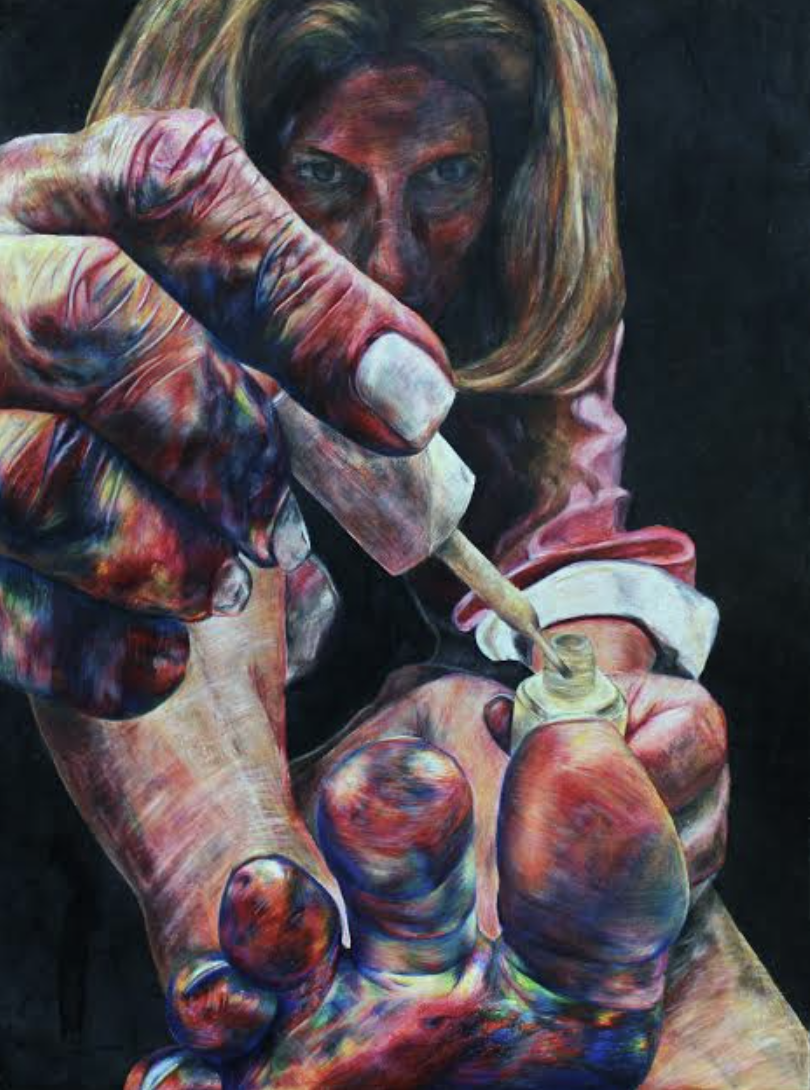
Trying to Nail It
Trying to Nail It was awarded the 2017 American Vision Award. The assignment for this piece was to foreshorten either the hands or the feet, but I chose to challenge myself by foreshortening both. Although the scale was large, I committed to working entirely in colored pencil, pushing the medium beyond what might typically be expected. With this work, I wanted to explore the conceptual possibilities of mark-making and exaggerated color. Throughout the process, I identified subtle undertones in my reference photo and intentionally amplified them, heightening the tension within the composition. Despite the vibrancy of the palette, the piece carries an eerie quality, created by the presence of deep, dark negative shapes. This contrast produces a paradox: an act often associated with femininity and ease—painting one’s nails—becomes laborious and almost unsettling. That sense of strain is intensified by the gaze of the model, my mother, whose expression shifts the moment from carefree ritual to something more complex and emotionally charged.
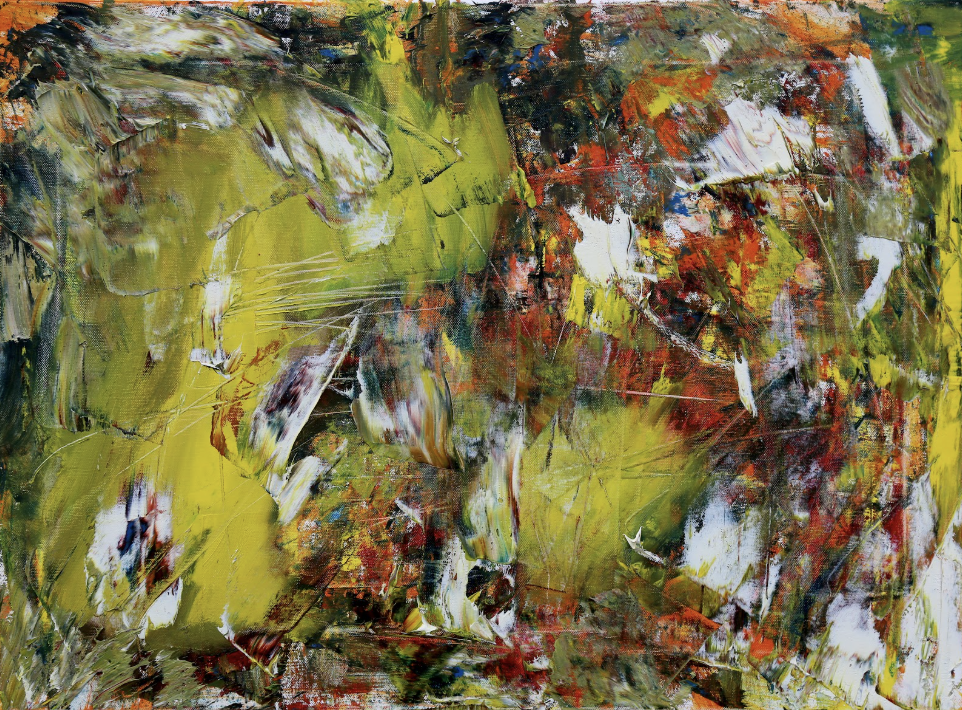
Noise
Noise was chosen to be displayed on the Rosemary Art Wall in City Place as a part of the 2017 Scholastic Art Awards. This work was a self-directed exploration rooted in experimentation. There was no reference image and no singular source of inspiration; instead, I allowed my mind to wander and guide the process organically. At the outset, I limited myself to warm tones, creating a boundary within which to begin. As the piece evolved, however, I lifted that restriction. What started as a study in constraint gradually transformed into an investigation of color interaction. I introduced new hues one by one, giving each mark space to exist independently before allowing them to converse, overlap, and ultimately merge.The result is an asymmetrical composition that feels both dynamic and resolved — a collection of individual gestures unified into a cohesive whole.
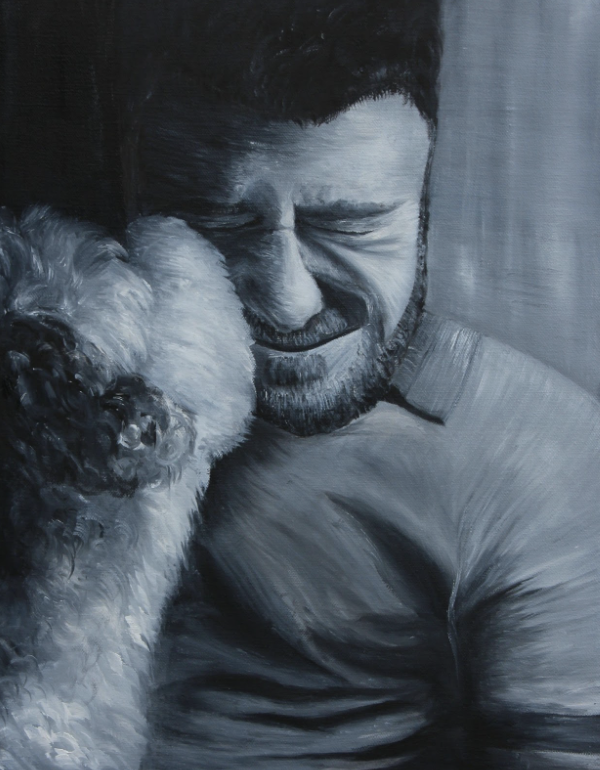
A Man’s Best Friend
For this assignment, I was asked to use any part of the human body as inspiration to construct a narrative in grayscale oil paint. I recruited my brother as my model and, in an effort to capture an authentic interaction, added a bit of peanut butter to his face to entice my dog to lick him. The result was an unguarded, intimate moment that became the foundation of the piece.The greatest technical challenge was distinguishing between the textures of my brother’s beard and my dog’s fur while working solely in grayscale. I approached this by juxtaposing softer, broader strokes for the fur with harsher, more deliberate marks for the beard, allowing texture — rather than color — to define each form.
Envy
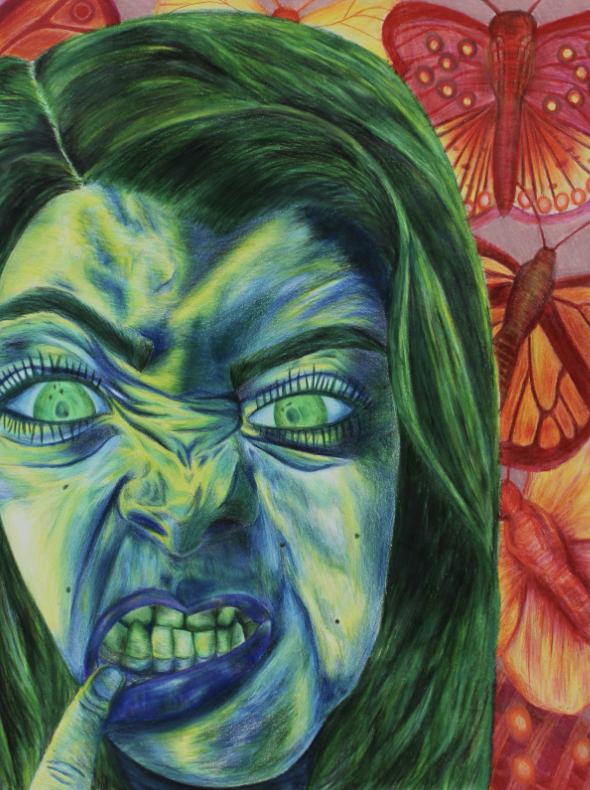
I am usually the one observing and portraying others, so stepping into the role of model felt deeply uncomfortable. In holding this pose, I unintentionally created an expressive self-portrait — one that confronted, rather than concealed, that discomfort. By leaning into the unease, I resisted the impulse to idealize myself and instead allowed the image to remain honest. Our assignment required us to designate either warm or cool tones to the subject or the background. At the time, I was also studying AP Art History, where I was reminded of the color red’s long-standing association with anger and intensity. I initially considered rendering the face in warm tones to emphasize emotion. Ultimately, however, I chose cool tones, allowing the expression itself — rather than the symbolism of color — to carry the emotional weight. The butterflies in the background extend the theme of contrast, this time through subject matter rather than hue. They introduce delicacy and transformation against the stillness of the portrait. On a more personal level, butterflies hold meaning in my family; my mother associates them with her late father. In that sense, this work quietly serves as a tribute to my grandfather, weaving personal memory into the broader exploration of color, emotion, and self-representation.
35 Years of Love
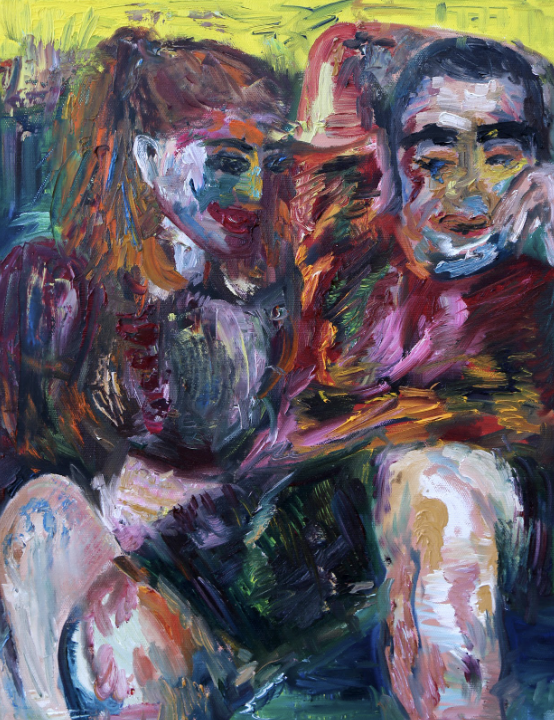
When I took the photograph that later became the foundation for this piece, I was simply moved by a fleeting moment of embrace. I captured it instinctively, without any intention of using it for an assignment. That same sense of spontaneity guided my approach to the painting itself. Rather than meticulously replicating the image, I allowed my hand to wander, responding intuitively to the composition. I observed the general tones and hues within each section of the photograph, then chose to amplify certain undertones, emphasize dominant colors, or at times introduce hues of my own. To maintain cohesion, I repeated select colors throughout the composition, creating visual rhythm and unity. This repetition became a conceptual metaphor: After 28 years of marriage and 35 years together, my parents remain distinct individuals who come together as one powerful, unified force — balancing one another’s strengths and compensating for each other’s weaknesses. Their connection feels organic and deeply earned, a kind of love that cannot be staged or manufactured. For that reason, I chose not to render the painting realistically; instead, I embraced expressive color and gesture to reflect the depth and authenticity of their bond.
Not An Apple
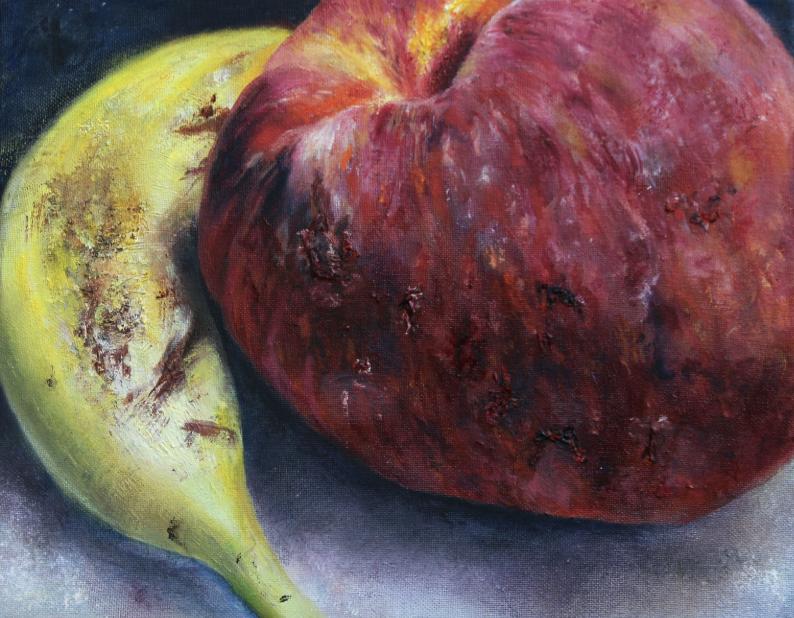
The assignment was to create an oil painting from direct observation, using a still life arrangement of fruit as the subject. The objective extended beyond accurate representation; we were asked to engage with the science, theory, and psychology of color while constructing a complex composition that maintained an illusion of light and form. I chose a banana and a peach, drawn to the harmony of their analogous hues. As I experimented with different arrangements, I became particularly interested in how the peach seemed to naturally nestle into the curve of the banana. Their interaction created an organic radial movement across the canvas, guiding the viewer’s eye in a subtle but compelling way. Even after carefully rendering the fruits, however, the painting felt incomplete. To resolve this, I scraped dried oil paint from my palette and selectively reintroduced it onto the surface, emphasizing the contours of both forms. This final gesture heightened their dimensionality and brought a tactile quality to the work, ultimately achieving the sense of resolution I had been seeking.
In the Nude
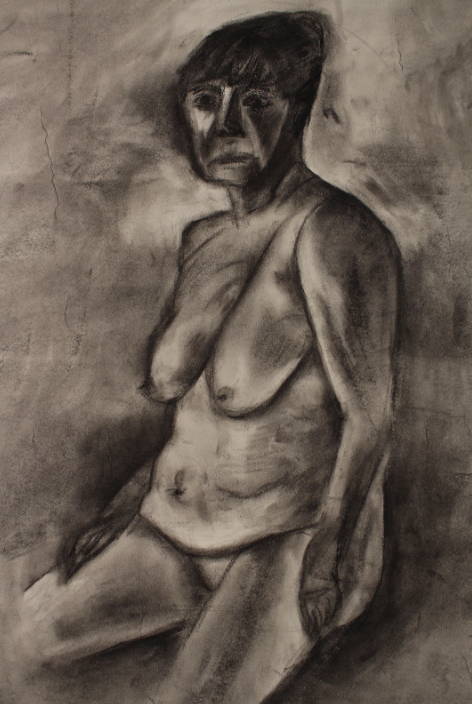
In afternoon classes at the University of Michigan Summer Portfolio Prep program, we frequently completed timed nude studies ranging from 15 to 45 minutes. These constraints forced decisiveness and encouraged me to work across the entire page before committing to detail — a discipline I have long struggled to maintain in nearly every medium. The repetition of these exercises strengthened my understanding of proportion and scale, while increasing my confidence in constructing the figure as a whole rather than in fragments. Drawing the nude form has also deepened my awareness of how clothing responds to the body, informing more convincing representations in subsequent work. Working from life introduced an immediacy that I find energizing. Capturing the subtleties of living flesh — shifts in weight, tension, and expression — required both observation and instinct. I also used these studies as an opportunity to experiment with mark-making. The seemingly simple, deliberate lines that shape a face can carry remarkable emotional weight, proving that restraint and intention are often more powerful than excess detail.
Nana & Me
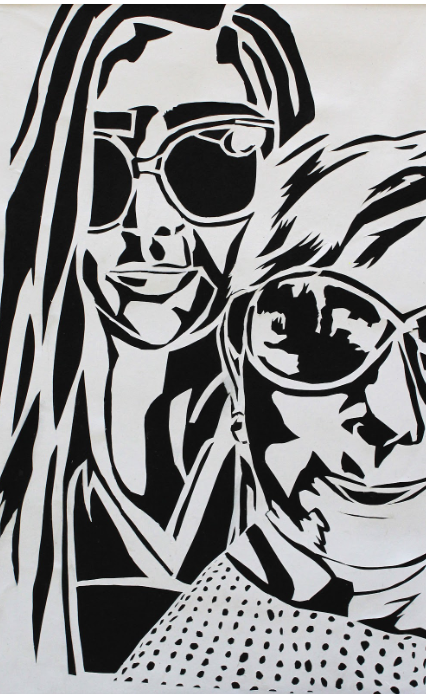
This piece is a self-portrait with my grandmother, whom I call Nana. Cut paper inherently emphasizes positive and negative space, requiring careful consideration of shape and silhouette. To push against the rigidity that can sometimes accompany the medium, I incorporated organic lines — particularly in the hair — and added polka dots to introduce movement and variation without compromising its structural clarity. My mother often says that Nana and I share the same personality and mannerisms, a connection I sought to highlight through our mirrored expressions and similar accessories. I chose to include the reflection of the surrounding atmosphere in Nana’s sunglasses, while leaving mine flat, as a quiet acknowledgment of perspective: At 80 years old, she carries a lifetime of experience and wisdom that I am just beginning to gather.
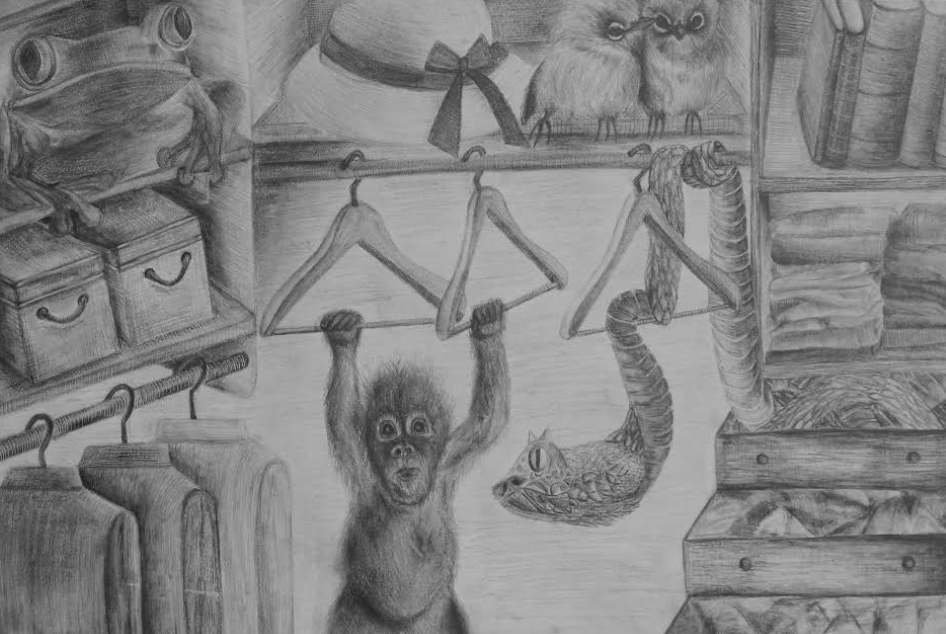
Takeover
Takeover received a Bronze Award in the 2016 Scholastic Key Competition. I was challenged to transform an everyday scene by inundating it with animals. I drew inspiration from my own closet as the setting, placing each animal in ways that parallel where they might exist in their natural habitats. Visual texture plays a key role in the piece: the snake is rendered with intricate, shaded detail, contrasting with the softer, wispy mark-making used for the monkey. The close proximity of the monkey and snake introduces a sense of tension, creating a subtle narrative within the composition.